

Can Re-Envisioning a Freeway Reverse Decades of Injustice and Exclusion?
Interstate 980 runs across Oakland, starting at the intersection of State Route 24 and I-580 to the north and ending at I-880 in the south. It’s a 2-mile spur of freeway with six exits that divides West Oakland from downtown. It tore a hole through the heart of a thriving Black community when it was built in the 1970s and 80s, and advocates have long called for its demolition. It made the Freeways Without Futures list in 2023, ranking as one of the top ten highways in the U.S. that needed to be removed.
Transform — working with Caltrans, Fehr & Peers, and local partners — will soon launch community outreach to create a vision for what could connect communities instead of what’s separated them for decades. Before we begin, it’s worth taking a look at the history of I-980 and the unjust roots of highway siting along the West Coast.
Planning through highway goggles
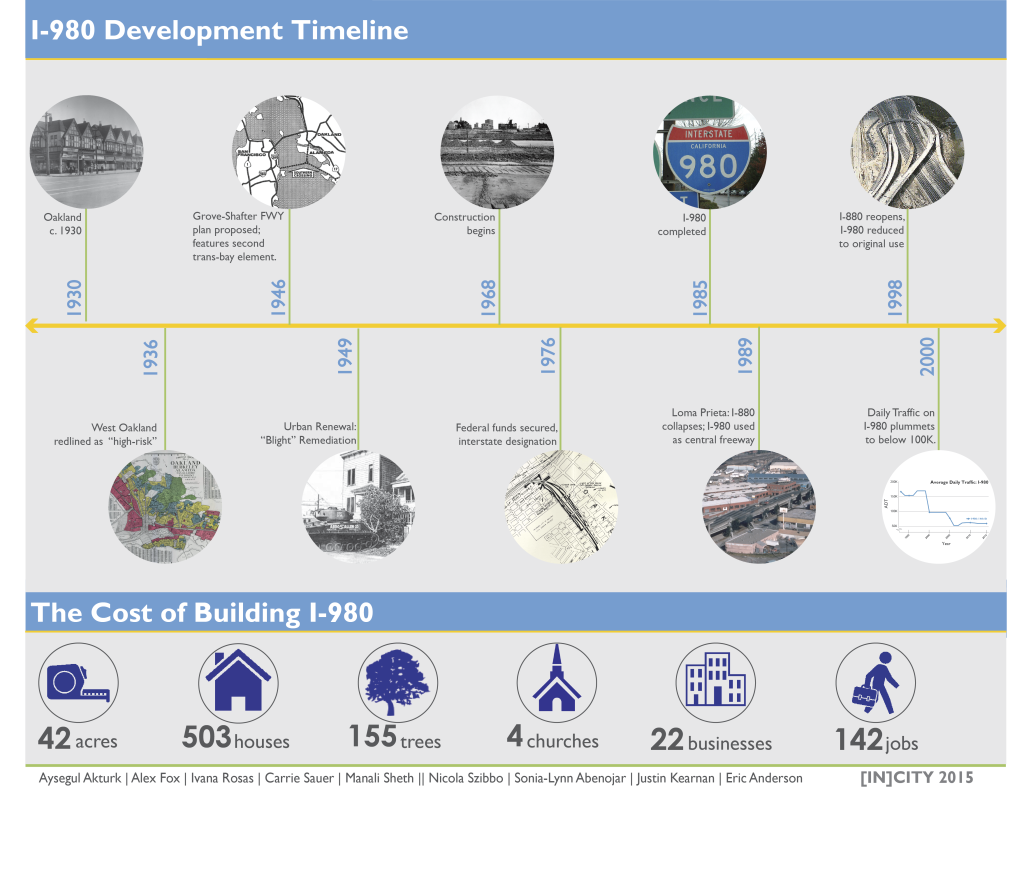
The history of “Interstate” 980, completed in 1985, begins decades earlier. As civic leaders and planners debated the future of downtown Oakland and possible locations for a second Bay Bridge, SR 24 was gradually extended south of 580. With the planned development of Oakland City Center as a destination for employment, elected officials saw a “need” for a highway through downtown.
To quote from the Federal Highway Administration Underwriting Manual, highways were “effective in protecting a neighborhood and the locations within it from… inharmonious racial groups.” This led to the selection of freeway alignments that cut through low-income, predominantly Black communities or intentionally created barriers between Black residents and other parts of cities, including predominantly white neighborhoods and central business districts.
The completion of the link from I-580 to I-880 took decades. During that period, the highway advanced by fits and starts while homes and businesses sitting in its path saw their property values diminish and their neighborhoods thin out.
With federal highway dollars and the designation of 980 as an interstate, Caltrans was able to complete the final segment in 1985.
“Urban renewal” was code for marginalizing highway construction
West Oakland was a dense, thriving neighborhood in the first half of the 20th century. It was an epicenter of Black culture and businesses, with nationally known performers stopping in to local clubs and abundant employment in the thriving Port of Oakland.
With the rise of automobile culture, cities needed to find room to build highways. They chose Black, Latino, and Chinese neighborhoods, calling the destruction of homes and businesses and their replacement with broad swaths of asphalt “urban renewal.” These policies split Oakland’s huge Chinatown in half for the construction of I-880, and they separated West Oakland from the port, ringing the neighborhood with freeways.
Walled-off West Oakland
The completion of I-980 marked the total barricading of West Oakland by highways on all sides. This cut off the neighborhood from the rest of Oakland and the East Bay. The 980 and similar highway projects “intentionally created barriers between Black residents and other parts of cities, including predominantly white neighborhoods and central business districts,”
contributing to the decline of the once-vibrant neighborhood.
West Oakland suffers from more than physical dislocation: the highways that ring the neighborhood bring pollution. The only area of Oakland with lower ratings on CalEnviroScreen is the region around the airport. Diesel trucks traverse the neighborhood on the way to and from the port, and the highways bring the area more than its share of freight traffic. As a result, children in West Oakland have asthma at seven times the California average.
Can re-envisioning be reparation?
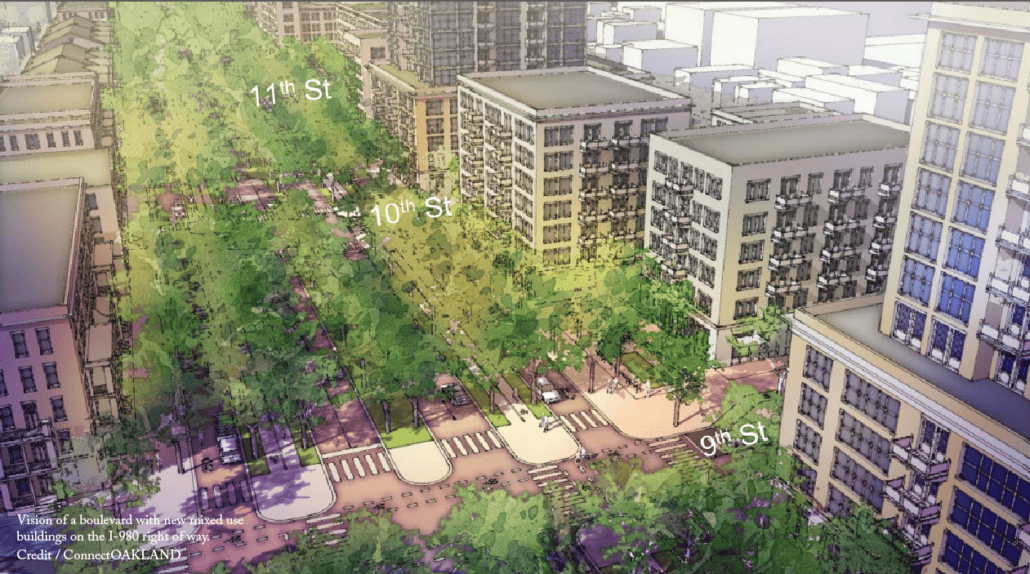
Just four years after I-980 was completed, the Loma Prieta earthquake collapsed a portion of I-880 in West Oakland known as the Cypress Structure. The revelation of the instability of the raised freeway overshadowing homes gave residents a rare opening, and they lobbied to have the broken connection rebuilt farther to the west. The result is Mandela Parkway, a linear park with green space, walking paths, and bikeways. It shows the possibilities for true urban renewal with the removal of a highway.
The I-980 highway was constructed over the objections of the neighborhood and with little consideration of residents’ well-being. The Vision 980 study strives to be the opposite: instead of outsiders dictating outcomes, local residents will be centered in the process. The Vision 980 Study – Phase 1 Report (November 2025) states: ”Most importantly, the study aims to confront the consequences of past governmental policies, restore trust, and redefine the role of the California Department of Transportation (Caltrans) as a community partner.”
This fall, Transform will begin working with neighborhood groups to develop a vision for what we could build in the space currently taken up by I-980. The goal is to include both community partners with a long history of improving West Oakland, residents, and the youth who will grow up and thrive in a reconnected city.
Nothing can bring back the homes, businesses, and lives uprooted by the 980 highway. By lifting up residents’ voices, we hope to facilitate the development of a future that celebrates and invigorates West Oakland.
Sources:
- Vision 980 Study – Phase 1 Report (November 2025)
- Vision 980 Phase I: Existing Conditions StoryMap
- Connect Oakland
- Freeways Without Futures 2023 – CNU
- An interactive history of California’s freeways, redlining and racism – Transfer Magazine
- Freeways force out residents in communities of color — again – LA Times
- OAKLAND: FREEWAYS & URBAN RENEWAL – Segregation by Design
- UCLA Report Shows How Freeway Construction Last Century Was Used to Destroy and Divide Communities of Color – Streetsblog CA
- The Implications of Freeway Siting in California: Four Case Studies on the Effects of Freeways on Neighborhoods of Color – UCLA Institute of Transportation Studies
- America’s Highway System Is a Monument to Environmental Racism and a History of Inequity – KQED
- How freeways bulldoze California communities of color – CalMatters
- Is Rising Heat Making It Harder for West Oakland to Breathe? – Knee Deep Times

